
Skip to product information
1 of 10

Antique Secretary Desk in Flamed Mahogany with White Marble Top | Louis Philippe Style | Mid-19th Century

Regular price
€1.495,00
Regular price
Sale price
€1.495,00
Tax included. Shipping calculated at checkout.

Unique piece, no restocking

The furniture from which he writes by hand.

And from whom he still keeps what matters under lock and key.

Warranty: +280 reviews: 4.9 /⭐️⭐️⭐️⭐️⭐️ Flawless delivery and unique pieces with premium service

RESTORED BY PROFESSIONALS

  • Structurally reviewed
  • Adjusted and reinforced where necessary
  • Treated against wood-boring insects and free from woodworm
  • Furniture ready for use

FREE Shipping (Peninsular Spain)

Returns 14 days (Peninsular Spain)

100% Easy and Secure Payment

Easy financing without expenses or interest

DESCRIPTION

One hundred seventy years ago, all bourgeois French homes had one. It was the discreet center of the house: here letters were written, family accounts were kept, and important documents, jewelry, love letters, and wills were stored. It had a lock because inside there was real private life.

Today it is no longer manufactured. Nobody writes by hand, nobody keeps letters. But the few secrétaires that were preserved—those that survived wars, inheritances, and moves—still function exactly the same way. And in a modern home, they are not a work desk: they are something else.

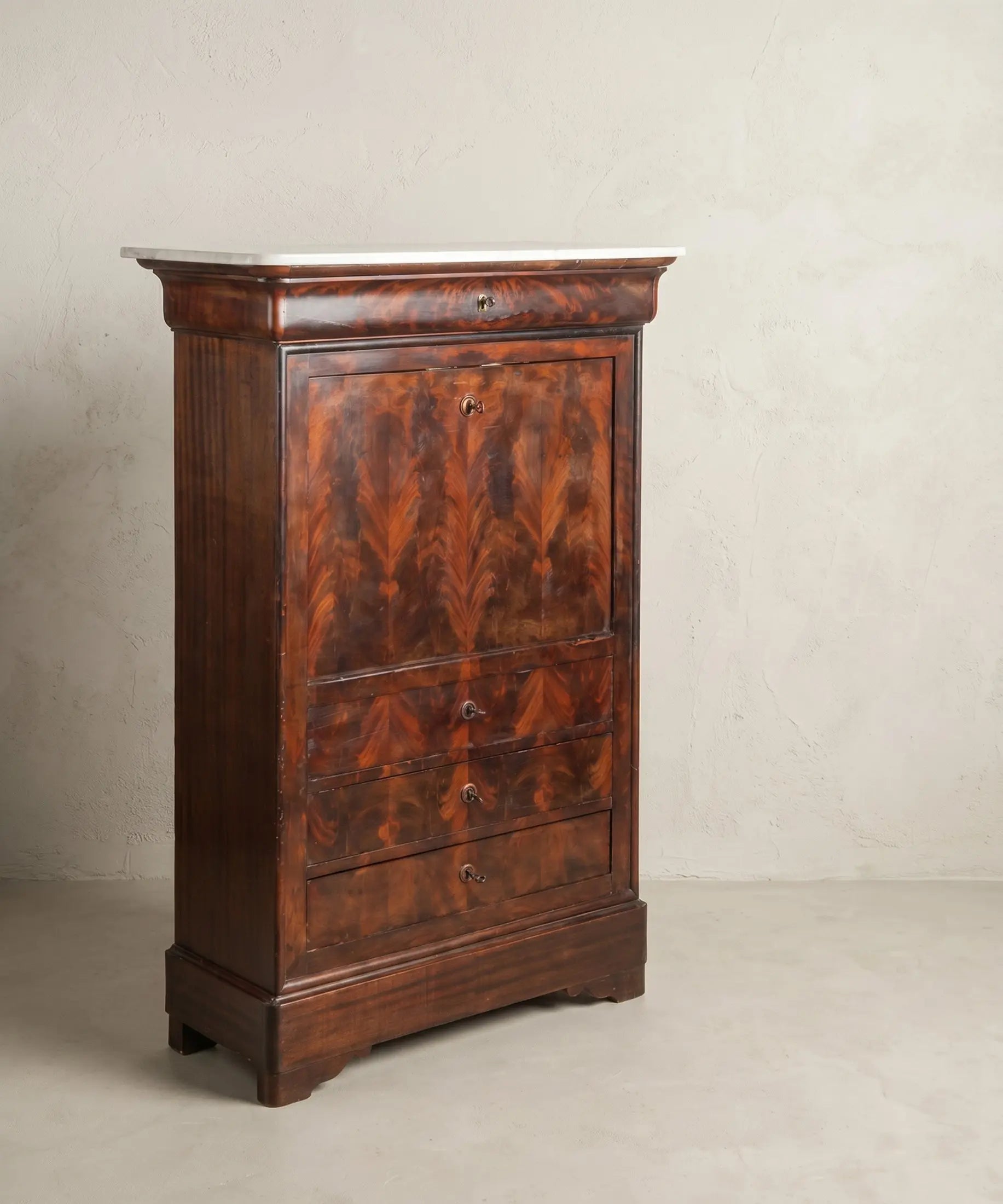
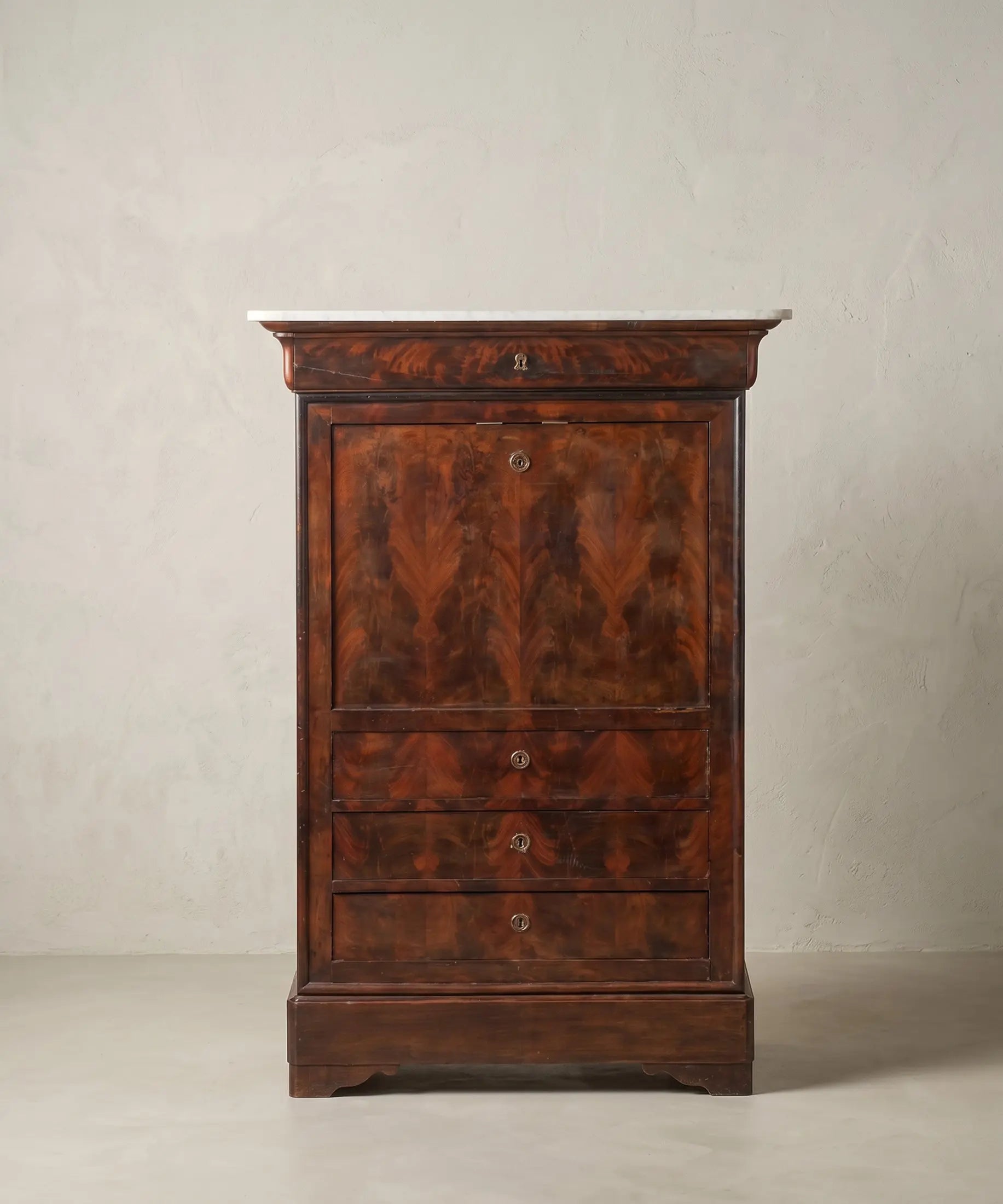
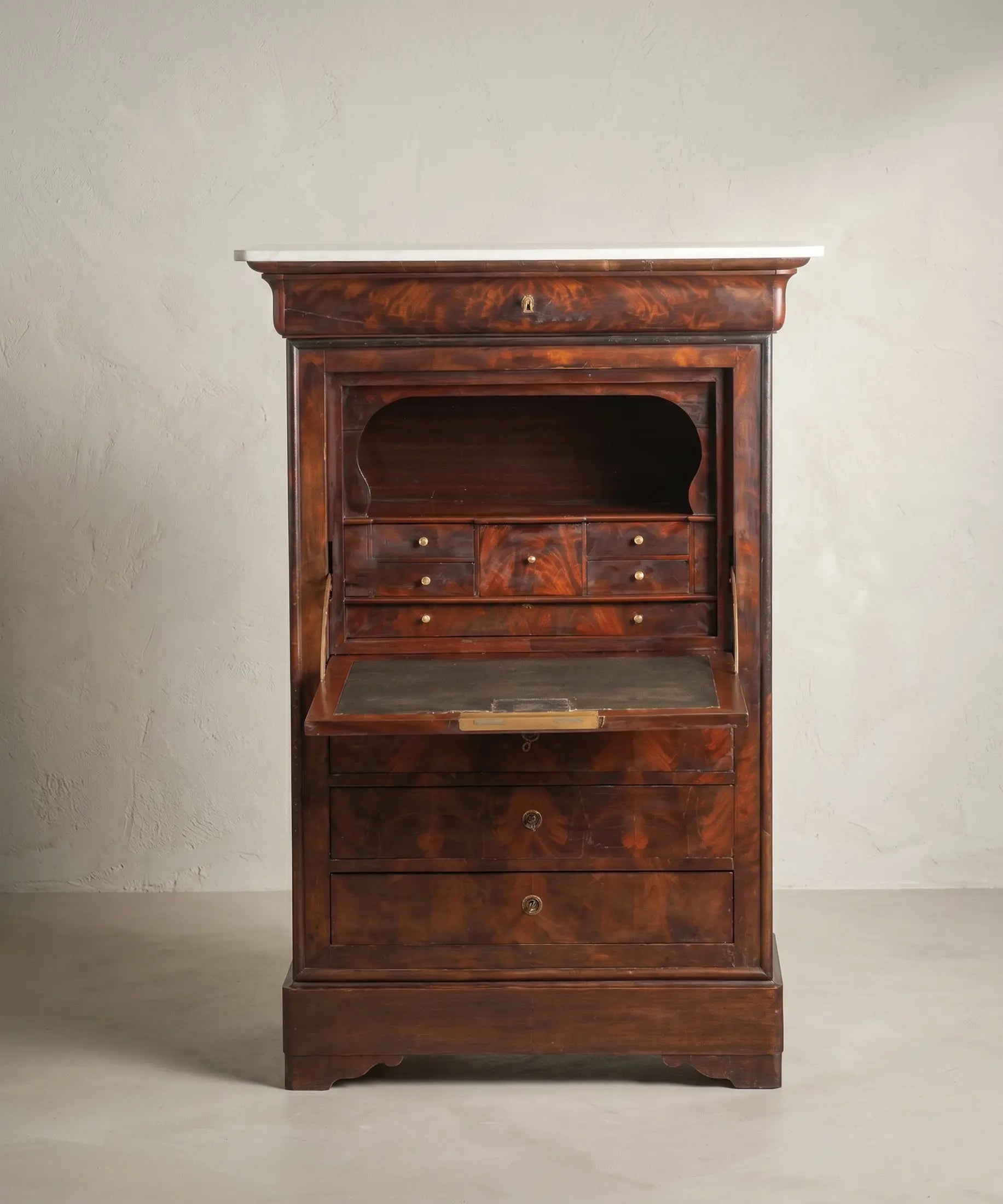
This secrétaire dates from the mid-19th century, made in France during the reign of Louis Philippe (c. 1840-1860). The Louis Philippe style is recognizable at first glance: the upper frieze with its characteristic S-shaped curve (the "moustache" that defines the period), the clean vertical lines without decorative carving, the straight feet. It is a style later than Rococo, later than Empire, earlier than Napoleon III. It works in current interiors precisely because it is not "ornate"—it is elegant in its line, not in its ornament.

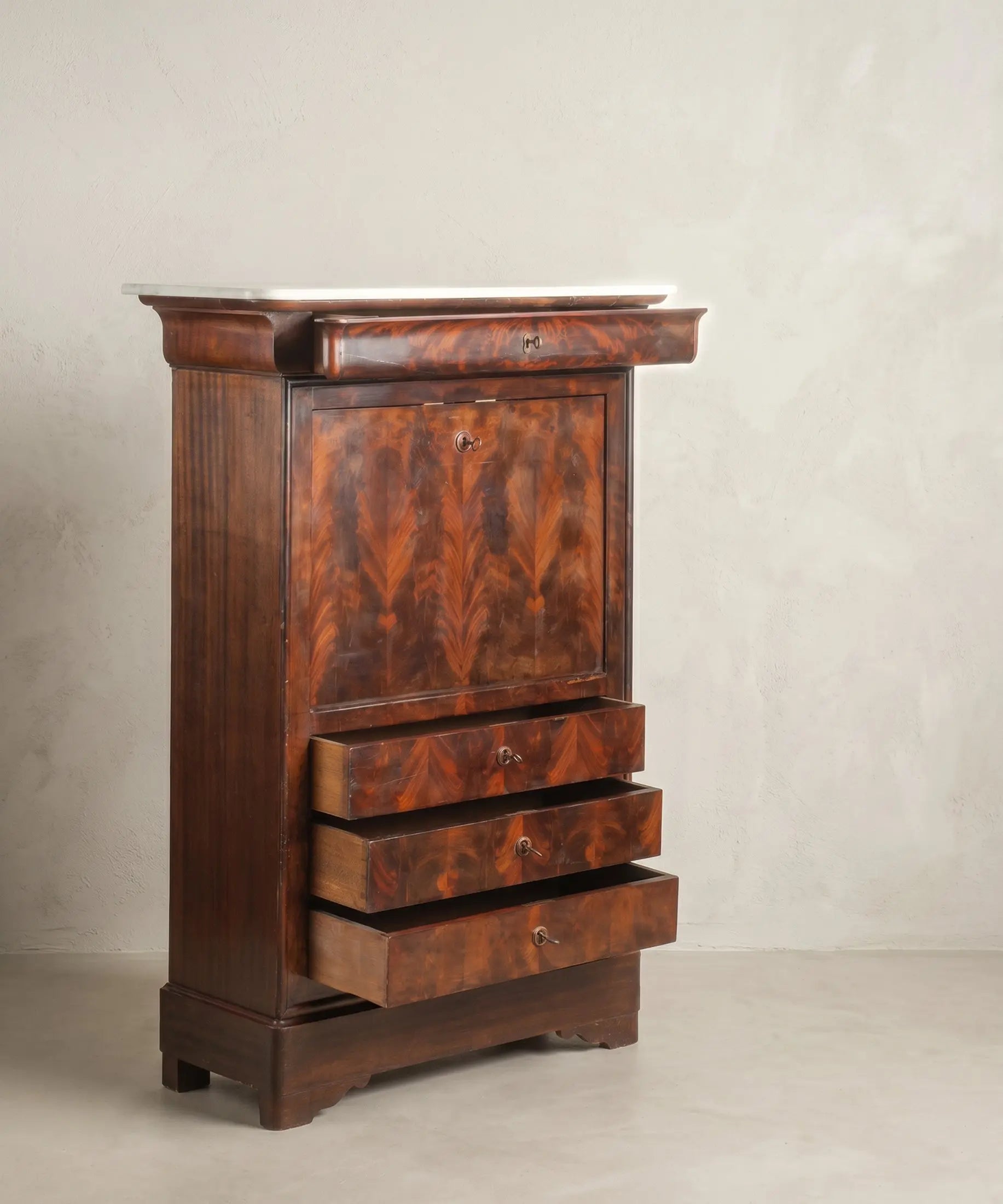
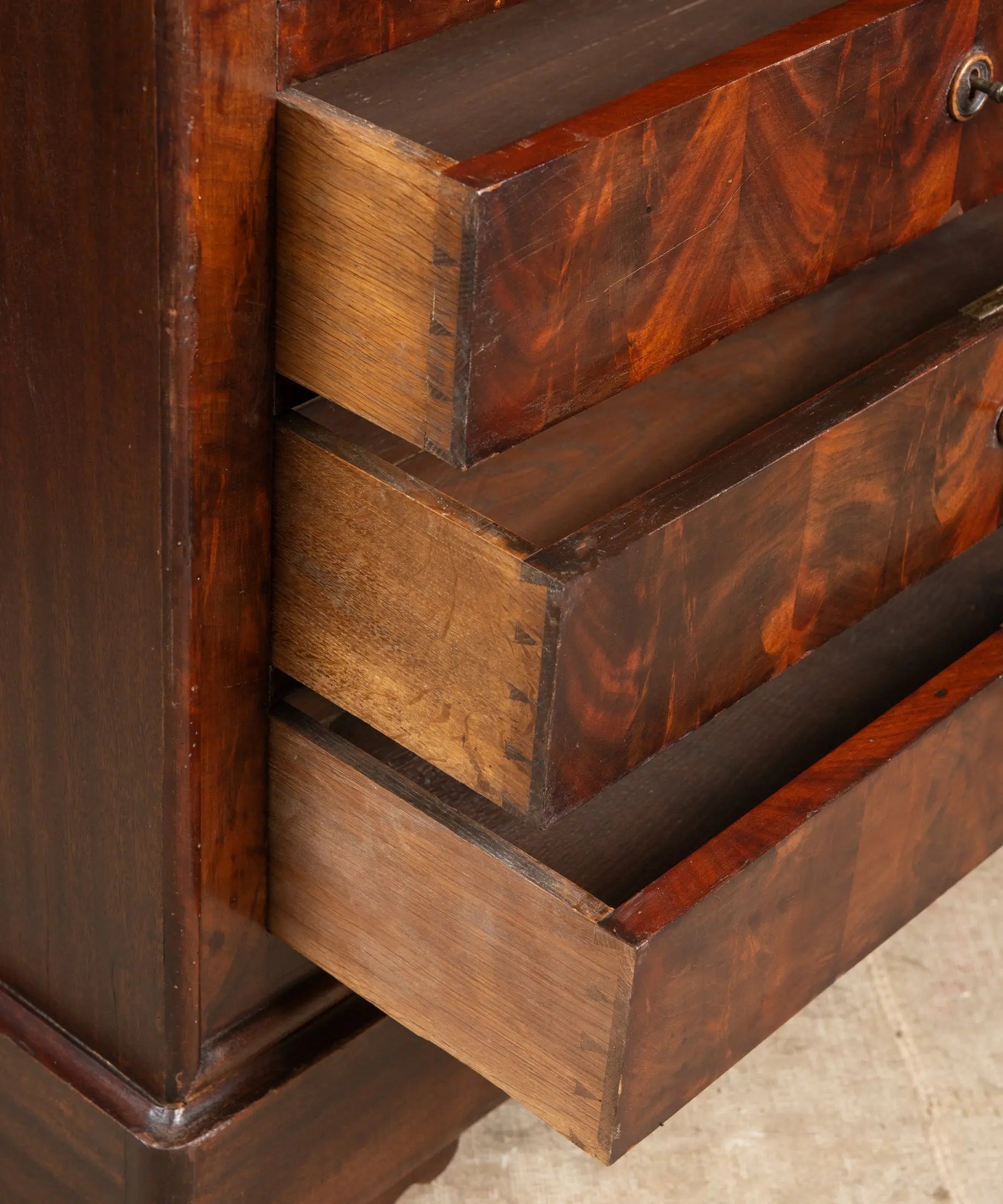
The wood is what separates a good secrétaire from an exceptional one, and this piece falls into the latter category. The entire facade is made of flame mahogany (acajou flammé): the flame- or feather-like grain that runs through each small drawer and panel. This grain is not added decoration or modern veneer. It was obtained by cutting the mahogany trunk in the area where the grain intertwined with a branch, and only a few such veneers could be obtained from an entire tree. This is what defines quality French 19th-century furniture. Today it is impossible to replicate industrially.

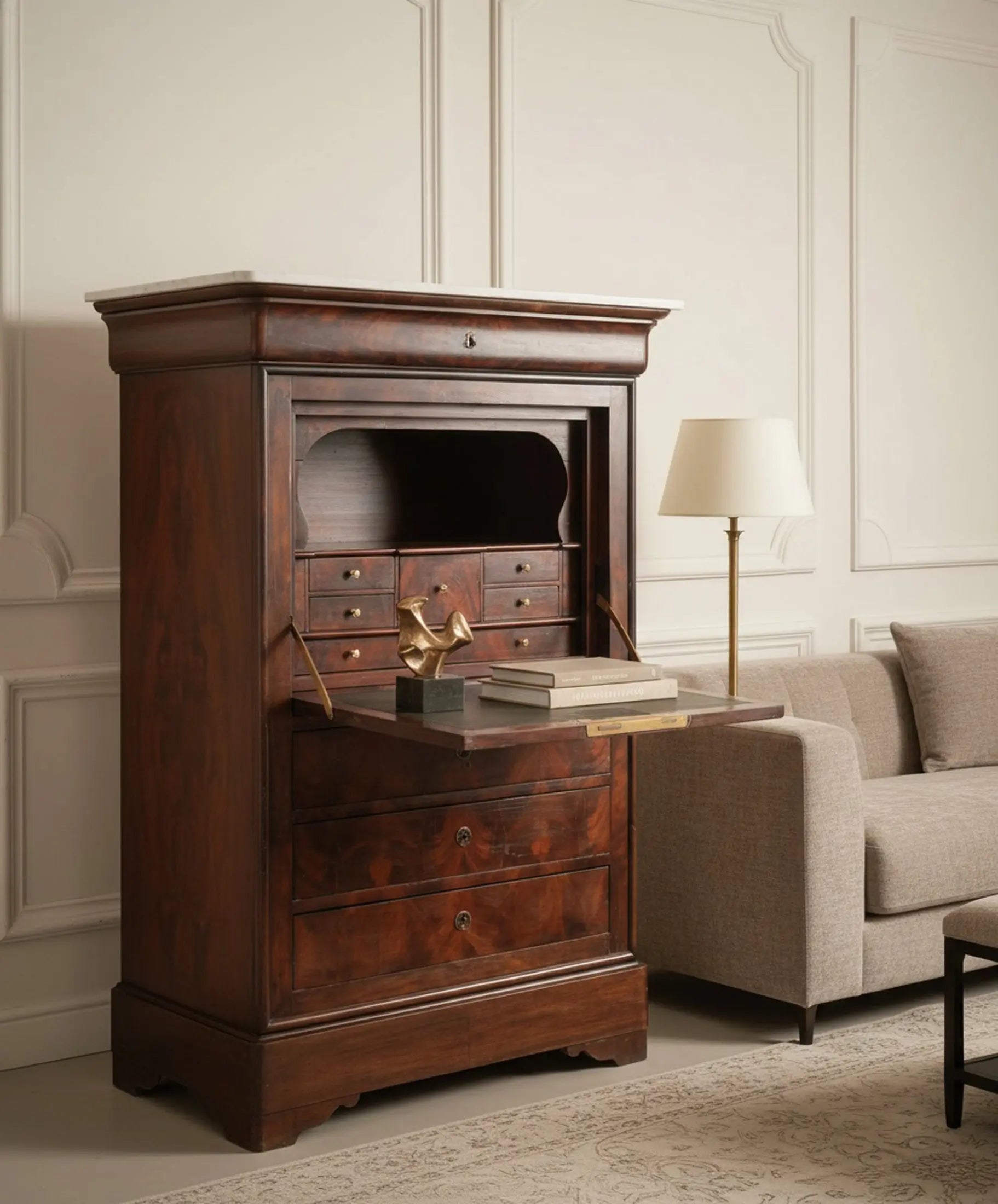
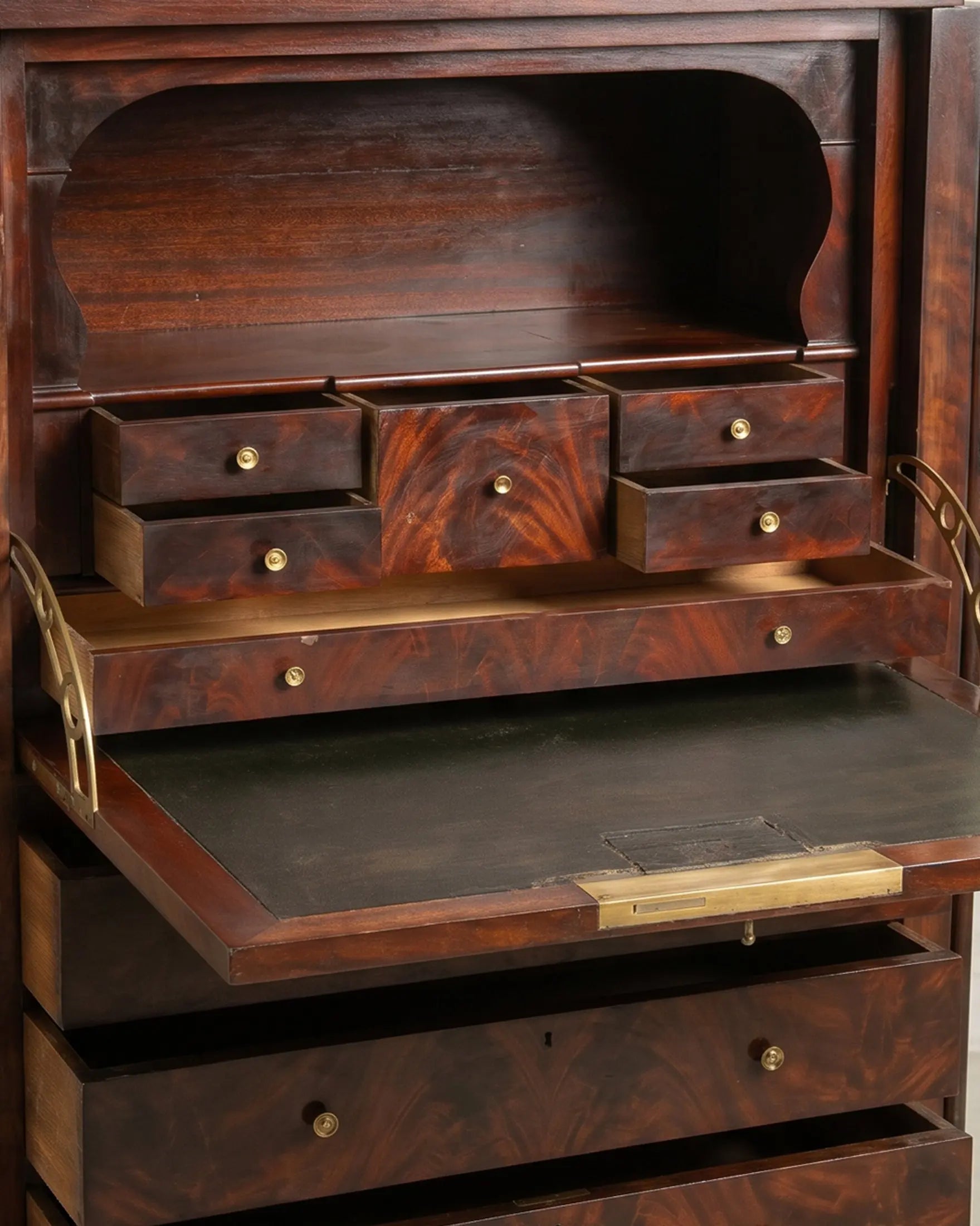
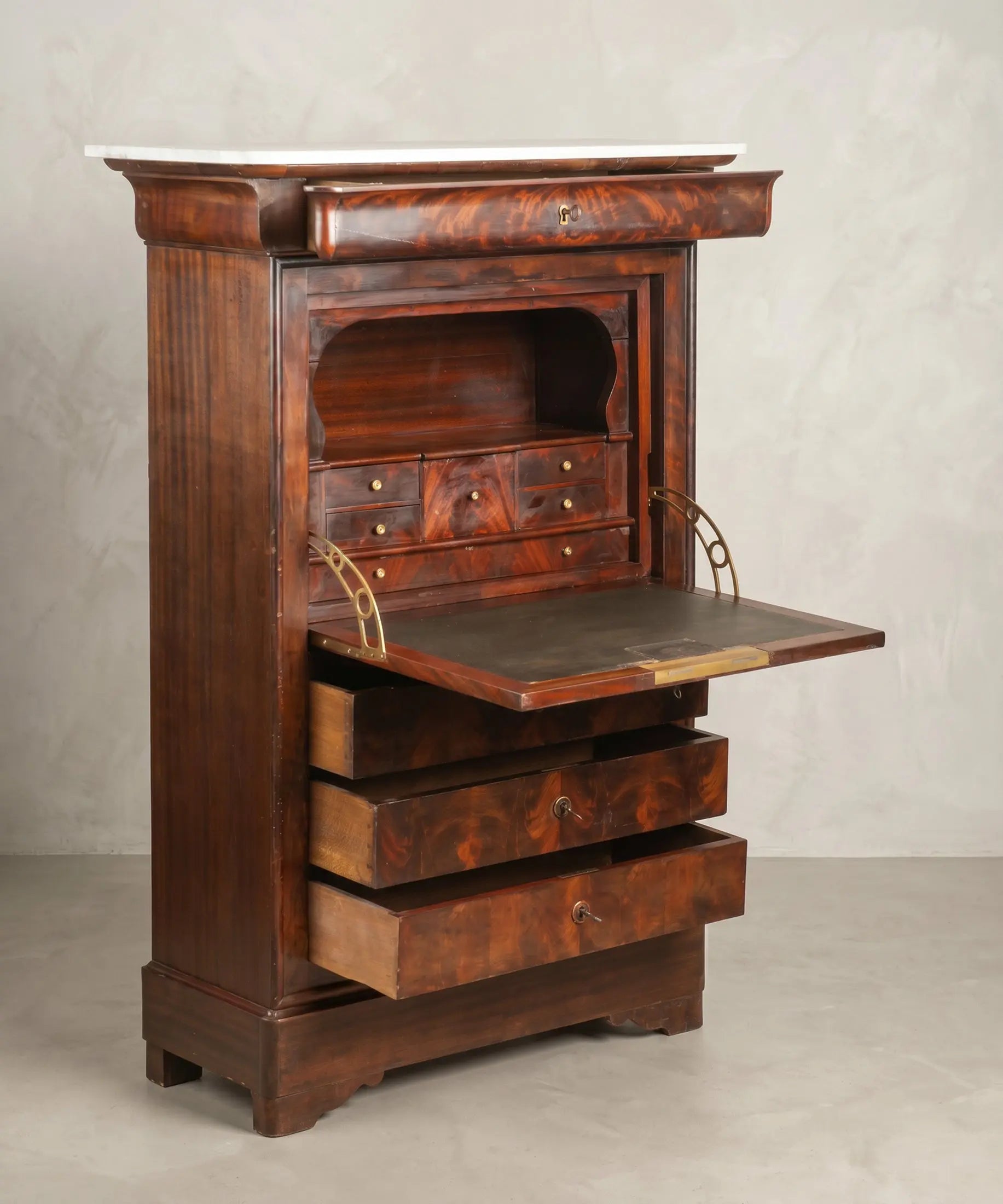
The central drop-front opens with its original key and reveals the interior, which is also executed in flame mahogany—even inside, a detail that only appears in pieces made by cabinetmakers, not by factories. Inside there is an upper niche with a lobed arch shape, six small drawers arranged on two levels to the left and right, and a continuous narrow drawer in the center. The side hinges are of calligraphic, decorative gilded bronze, typical of the Louis Philippe style. The drop-front, when lowered, becomes a solid writing surface supported by two gilded bronze metal arms.

The original writing surface is dark green leather, preserved as it arrived. It shows wear—there is a darker area in one corner where 170 years of resting elbows left their mark. It has not been replaced. A shiny new surface would be a mistake: that honest wear is what tells the story of the piece. It is worth more this way.

Below the drop-front, three large continuous drawers, each with a lock (four locks in total, counting the frieze and the drop-front). The four original keys are preserved. And at the very top, the piece's original white marble top, in intact condition with no restorations.

The dimensions are what make this secrétaire particularly interesting for a modern home. 87 cm wide, 36 cm deep, 152 cm high. It is narrow and VERY shallow—that depth of only 36 cm is what differentiates a well-made 19th-century piece of furniture from any modern piece: it fits into narrow spaces where modern furniture would not. And its 152 cm height gives it vertical presence without occupying floor space: a tall and slender piece, not low and wide.

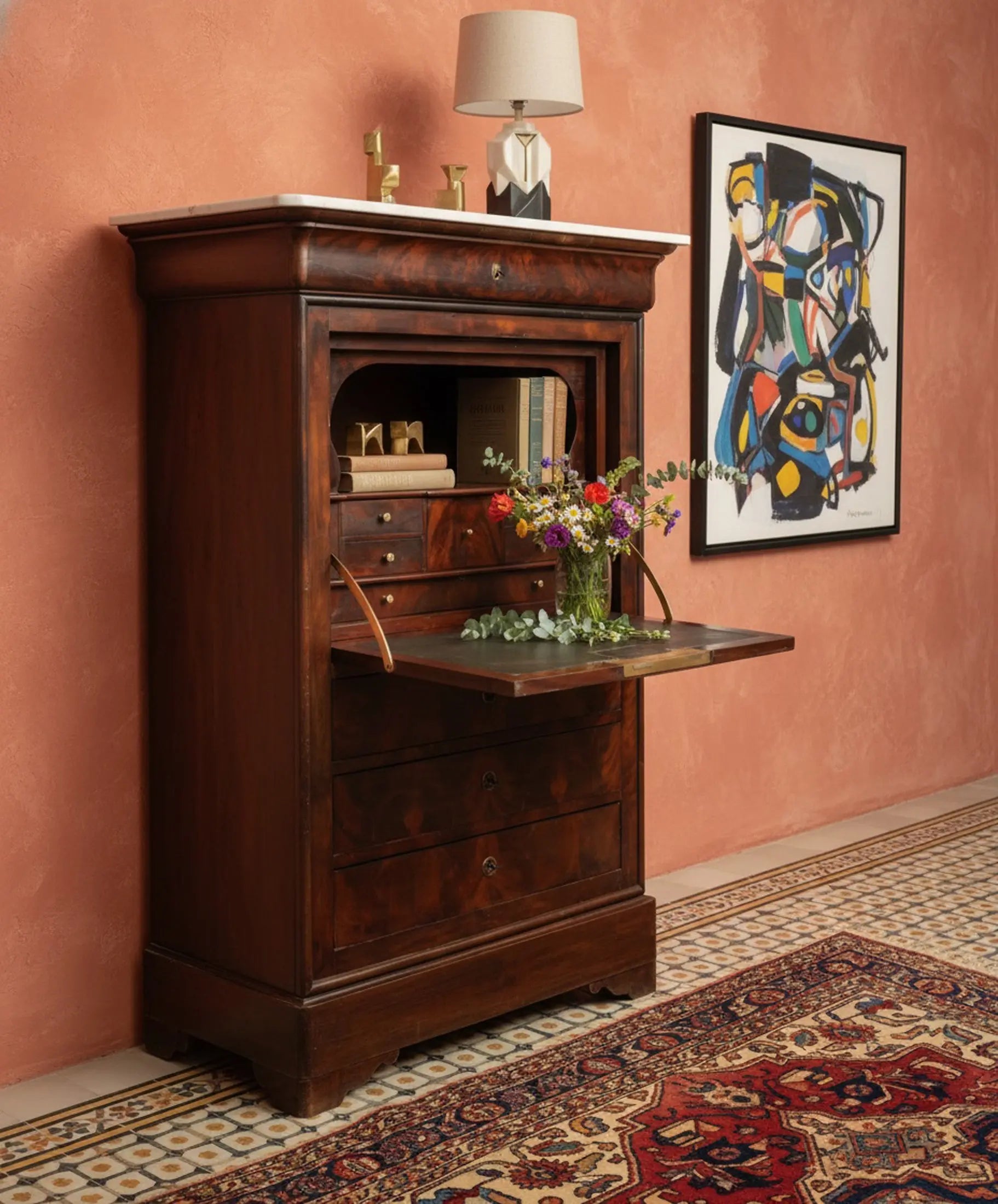
It works as a main piece in a small living room, in a bedroom with limited space, in an entrance with a narrow wall where a chest of drawers would never fit, or as an elegant corner in a study. In style, it effortlessly combines with formal European interiors (light boiseries, grey sofa, gilded lamp—Paris 6ème style) but also with contemporary eclectic interiors where the contrast between the antique mahogany and, for example, a terracotta wall with a contemporary abstract painting, works especially well. It is a piece of furniture that is not tied to a single style.

Excellent state of conservation. The flame mahogany retains its original varnish, without sanding that would have destroyed the grain. Intact marble. Original green leather writing surface preserved as is. Original gilded hinges and bronzes. The four original keys are functional. The structure is completely solid, and all drawers—the three large ones and the six small interior ones—slide correctly.

A unique piece, difficult to find complete. Most surviving secrétaires have lost the marble, or the writing surface, or the keys, or have a damaged interior, or the mahogany has been re-sanded (destroying the flame grain). This one is complete.

── WHAT WE LIKE MOST ABOUT THIS PIECE ──

→ The flame mahogany on the facade and interior. The flame grain that runs through each panel and each small drawer is of a veneer quality no longer produced. Key detail: the interior is also executed in flame mahogany, not cheap hidden wood—this was only done in pieces by real cabinetmakers.

→ The original green leather writing surface with 170 years of wear. The darker mark in the corner where an elbow rested. This is the difference between an antique piece of furniture and a reproduction: time is visible.

→ The slender dimensions. 36 cm deep is what makes a large piece into furniture that can truly be placed in modern urban apartments. The verticality (152 cm) gives it presence without occupying floor space. It is the opposite of a "low and wide chest of drawers."

── RESTORED IN OUR WORKSHOP IN NAVALCARNERO, MADRID ──

We checked the structure, the three large drawers, and the six small interior drawers. We checked the four locks and verified that the four original keys work correctly. We greased the gilded bronzes of the drop-front hinges and the support arms. We treated the wood against wood-boring insects. The flame mahogany was NOT sanded—that would have been a mistake that would have destroyed the original grain—it was simply hand-cleaned and nourished with neutral wax. The green leather writing surface was kept as is, respecting the original wear. The marble top was cleaned and seated firmly in its position. The piece arrives ready to enter a home.

A piece selected and restored by Antique Arte y Decoración—specialized since 2015 in antique furniture, with its own workshop in Navalcarnero, 30 minutes from Madrid, and serving over 3,500 families throughout Spain.

Material AND FINISH

Style: Louis-Philippe, France
Material: Flamed mahogany (acajou flammé) on front and interior, white marble (probably Carrara) on top
Finish: Original varnish preserved, no sanding or repainting
Hardware: Gilt calligraphic bronzes on drop-front hinges and support arms, original bronze locks with four original keys preserved
Structure: Continuous curved frieze top drawer (S-shaped Louis Philippe style), central drop-front with original green leather, interior with arched upper niche, six small drawers on two levels and a narrow continuous central drawer, three large continuous lower drawers
Mat: Original dark green leather preserved with honest wear from use
Marble: Original solid white, no restorations
Dimensions: 87 cm (Width) × 36 cm (Depth) × 152 cm (Height)
Weight: 70 kg
Condition: Excellent general preservation, original varnish intact, original marble and hardware
Period: Mid-19th century (c. 1840-1860)
Origin: France

MEASURES

87 cm (Width) × 36 cm (Depth) × 152 cm (Height)

SHIPMENTS

Free shipping to the peninsula. Includes delivery inside the home with packaging removal. Due to its height (152 cm), weight (70 kg), and the separate marble top, we arrange transport with companies specializing in antique furniture. Custom packaging, marble packed separately, insurance throughout the journey.

Antique Secretary Desk in Flamed Mahogany with White Marble Top | Louis Philippe Style | Mid-19th Century

Preguntas frecuentes

¿Qué es exactamente un secrétaire abatant?

Es un mueble francés del XIX, vertical, que combina almacenaje (cajones) con superficie de escribir (tapa abatible que se baja para formar una mesa). En las casas burguesas del XIX era el centro discreto del hogar: aquí se escribían las cartas, se llevaba la contabilidad, se guardaban documentos importantes, joyas y cartas privadas. Tenía llave porque su contenido era íntimo. Es un mueble que ya no se fabrica industrialmente: hoy se valora por su calidad de ebanistería, sus dimensiones esbeltas y por convertirse en pieza de carácter en interiores actuales.

¿Qué es la caoba flameada y por qué importa?

La caoba flameada (acajou flammé o flame mahogany) es el veteado en forma de llamas o plumas que se obtenía cortando el tronco en la zona donde la fibra se entrecruza con una rama. Solo se conseguían unas pocas chapas así por árbol entero, lo que la convertía en material de alta calidad reservado a piezas finas. Es imposible de replicar industrialmente con chapas modernas. En este secrétaire la caoba flameada aparece tanto en la fachada como en el interior (detalle clave de calidad: las piezas baratas usaban madera común por dentro).

¿Tiene la llave? ¿Funciona la cerradura?

Sí. Conserva las cuatro llaves originales (frisa superior, tapa abatible y los tres cajones grandes inferiores). Las cuatro cerraduras funcionan correctamente. El sistema de llave única que abre múltiples cerraduras del mismo mueble es típico del XIX y difícil de encontrar conservado.

¿Qué medidas tiene y dónde encaja?

87 cm de ancho, 36 cm de fondo, 152 cm de alto. Las dimensiones lo hacen especialmente interesante para casas actuales: el fondo de solo 36 cm permite colocarlo en huecos estrechos donde una cómoda moderna (50-60 cm de fondo) no entra. La altura le da presencia vertical sin ocupar suelo. Funciona como pieza principal en salón pequeño, dormitorio con espacio limitado, entrada estrecha, o como punto focal en un estudio.

¿Por qué el tapete de cuero tiene desgaste? ¿No se cambia?

El tapete de cuero verde es original (170 años). Tiene desgaste honesto del uso — incluyendo una zona más oscura en una esquina donde se apoyaba el codo al escribir. Decidimos NO sustituirlo. Un tapete nuevo de cuero brillante sería un error: ese desgaste cuenta la historia de la pieza y es lo que diferencia un mueble antiguo auténtico de una reproducción. Vale más con ese desgaste que con uno nuevo.

¿Qué trabajo se ha hecho en el taller?

Revisamos la estructura, los tres cajones grandes y los seis cajoncitos pequeños interiores. Comprobamos las cuatro cerraduras con sus llaves originales. Engrasamos los bronces dorados de las bisagras y brazos de sostén de la abatible. Tratamos la madera contra xilófagos. La caoba flameada NO se lijó — ese hubiera sido un error grave que habría destruido el veteado original — solo se limpió a mano y alimentó con cera neutra. El tapete de cuero se conservó tal cual. La tapa de mármol se limpió y asentó. Trabajo realizado en nuestro taller especializado de Navalcarnero, a 30 minutos de Madrid.

¿Cómo se gestiona el envío de una pieza de 152 cm de alto?

El envío es gratuito a toda la Península. Por la altura, el peso (70 kg) y la tapa de mármol independiente, gestionamos el transporte con empresas especializadas en muebles antiguos. La pieza se embala a medida, el mármol se embala por separado para evitar tensiones, y va con seguro durante todo el trayecto. Entrega en el interior del domicilio con retirada de embalaje.

¿Qué garantías ofrece Antique Arte y Decoración?

Llevamos desde 2015 especializados en la selección y restauración de muebles antiguos. Más de 3.500 familias en toda España y una valoración de 4,9 sobre 5 en Google. Puedes contactarnos antes de comprar para cualquier consulta sobre la pieza o para pedir fotos adicionales de cualquier detalle (interior abierto, llaves, mármol, etc.).