
Skip to product information
1 of 9

Antique Ebonized Bookcase with Balusters and Figurative Carvings | Breton Renaissance Style

Regular price
€1.150,00
Regular price
Sale price
€1.150,00
Tax included. Shipping calculated at checkout.

Unique piece, no restocking

A bookstore with soul.

The kind serious book lovers used to have.

Warranty: +280 reviews: 4.9 /⭐️⭐️⭐️⭐️⭐️ Flawless delivery and unique pieces with premium service

RESTORED BY PROFESSIONALS

  • Structurally reviewed
  • Adjusted and reinforced where necessary
  • Treated against wood-boring insects and free from woodworm
  • Furniture ready for use

FREE Shipping (Peninsular Spain)

Returns 14 days (Peninsular Spain)

100% Easy and Secure Payment

Easy financing without expenses or interest

DESCRIPTION

If you have antique books at home, you already know the problem: glass-fronted bookcases ruin the spines. Humidity rises, doesn't circulate, and the binding sticks or swells over the years. Open shelves are worse: dust everywhere, the books yellow.

The solution was invented in the 19th century and is called a baluster.

Instead of glass in the doors, a row of hand-turned solid wood columns separates the interior from the exterior. They protect from dust. But they allow air to pass through. Books breathe, preserve their binding, and don't yellow. It was the standard format for the French bourgeois bookcase of the late 19th century, when having a private library at home was a mark of authentic culture, not a decorative detail. People who knew about books put good books here.

That is what this piece is.

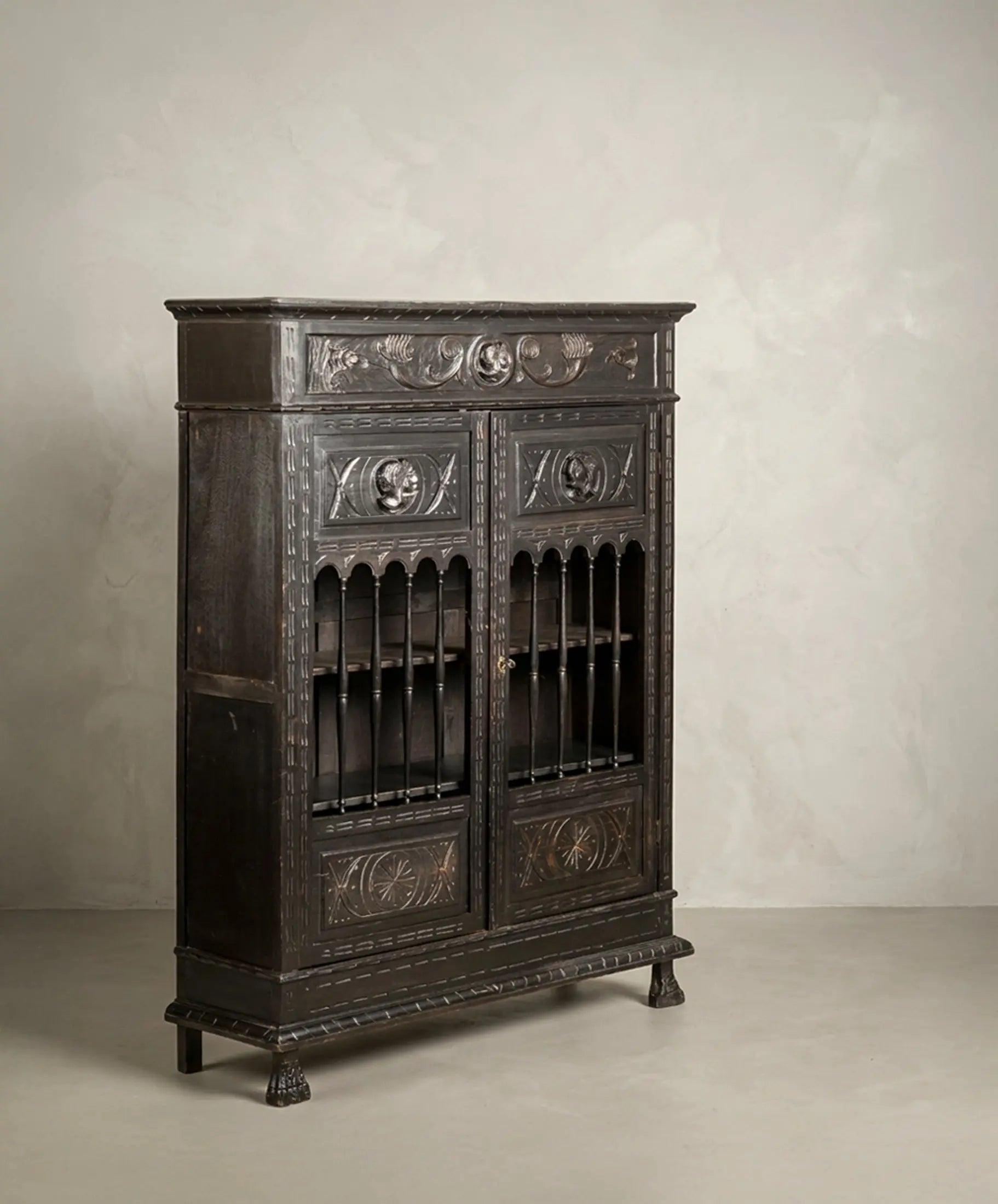
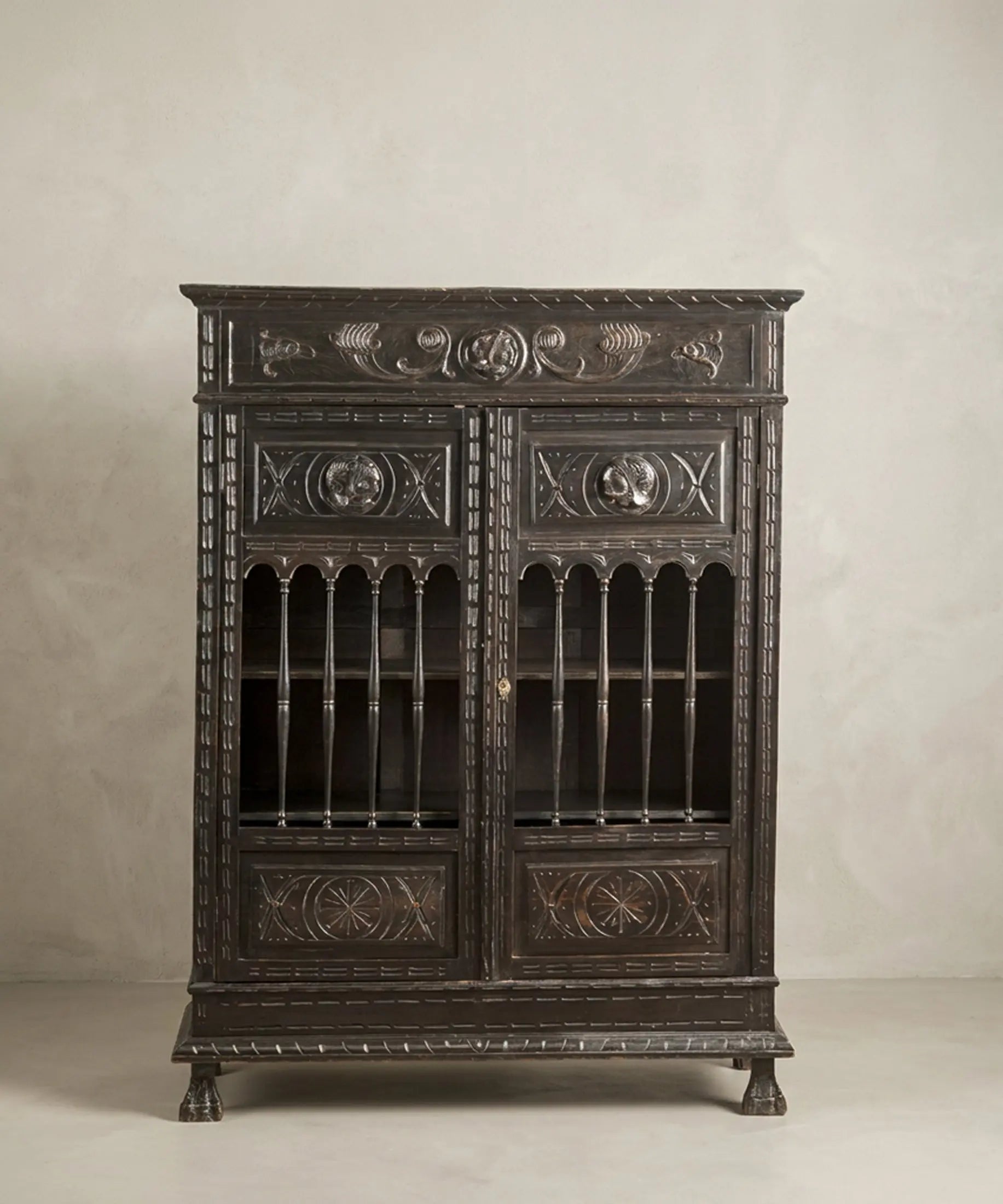
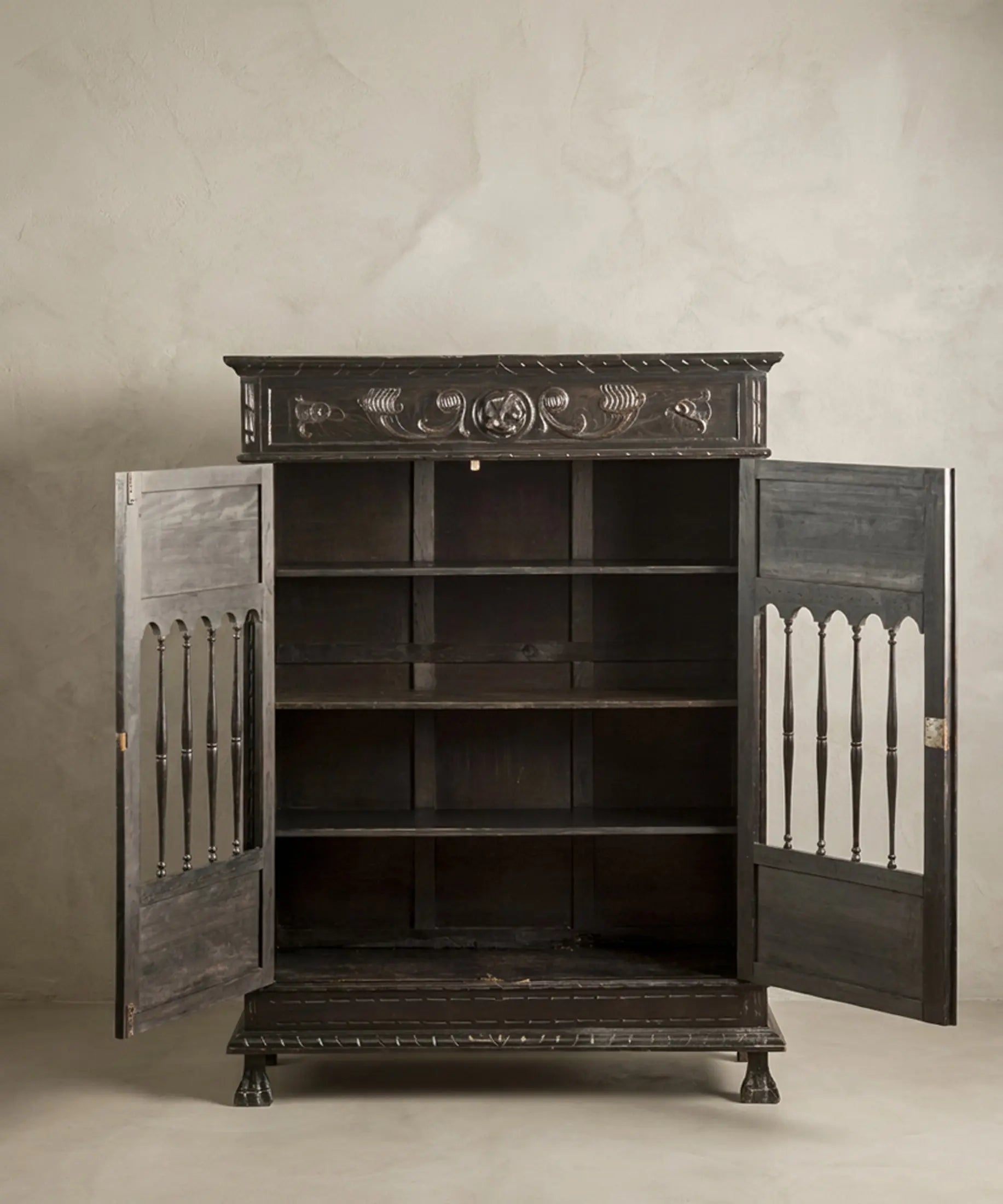
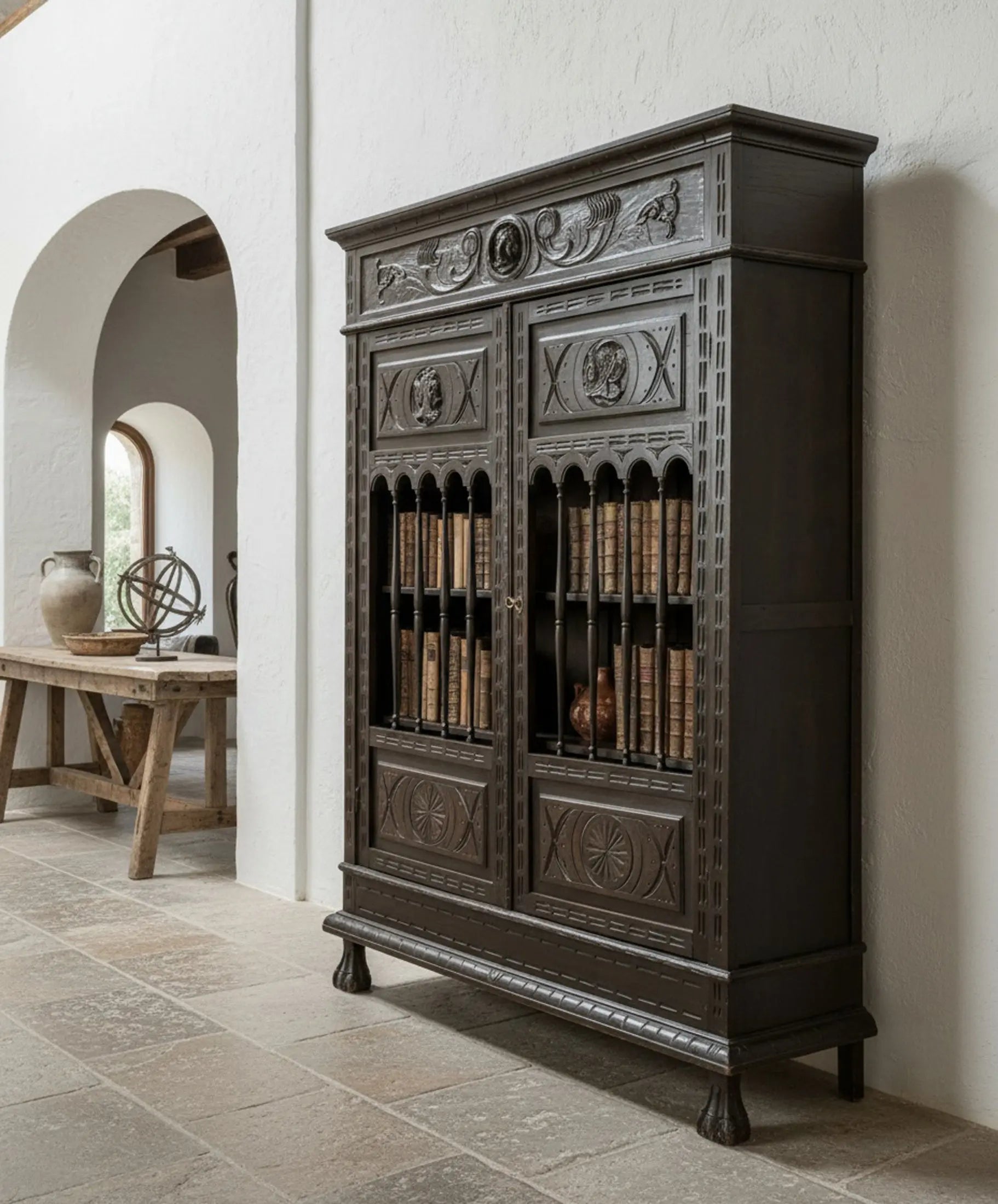
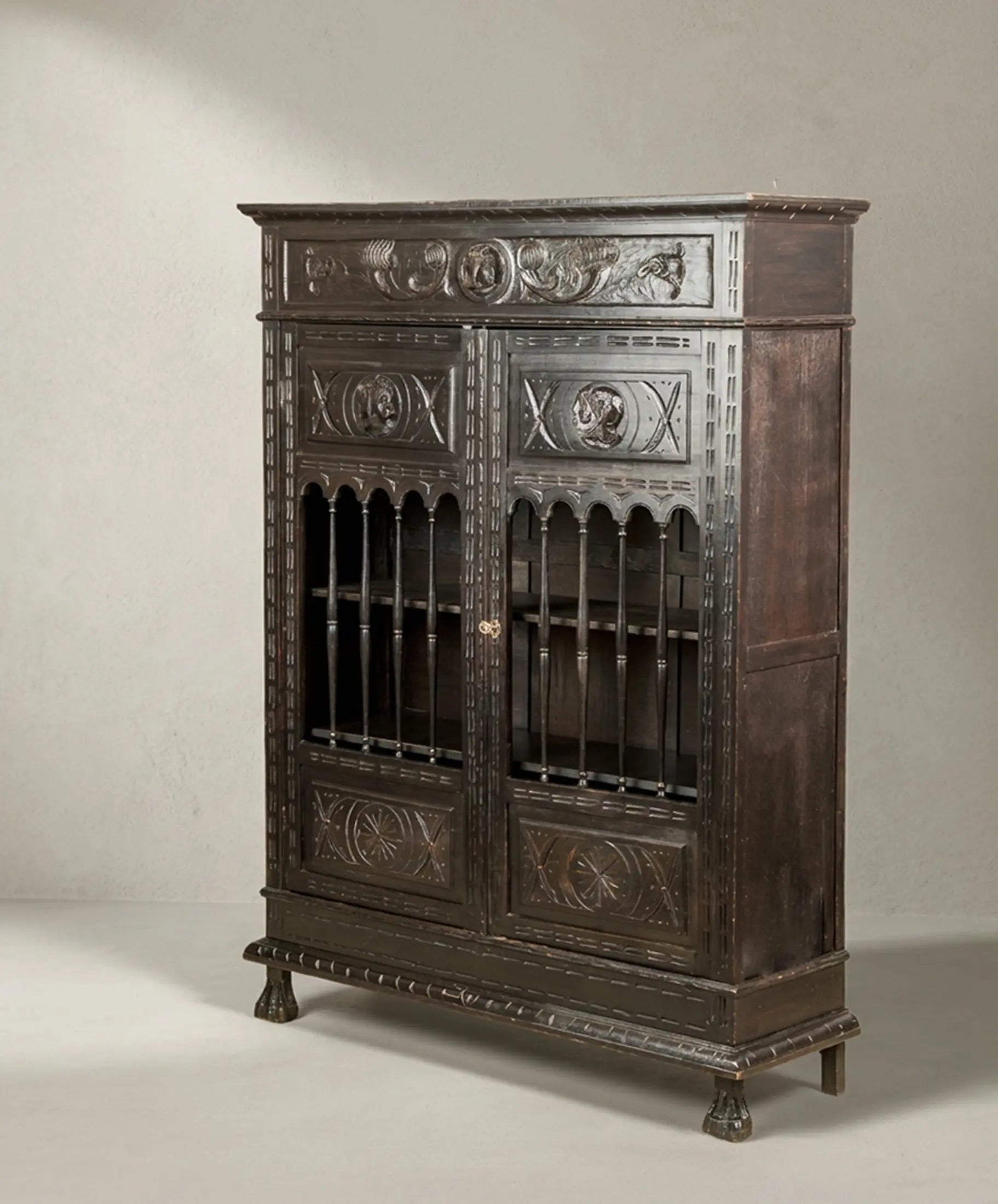
A French bookcase from the late 19th or early 20th century, Renaissance Revival (Henri II) style, probably of Breton origin due to the carved figurative motifs. Solid wood structure, two wide doors with central lock, continuous upper frieze, and three interior shelves creating four levels for books.

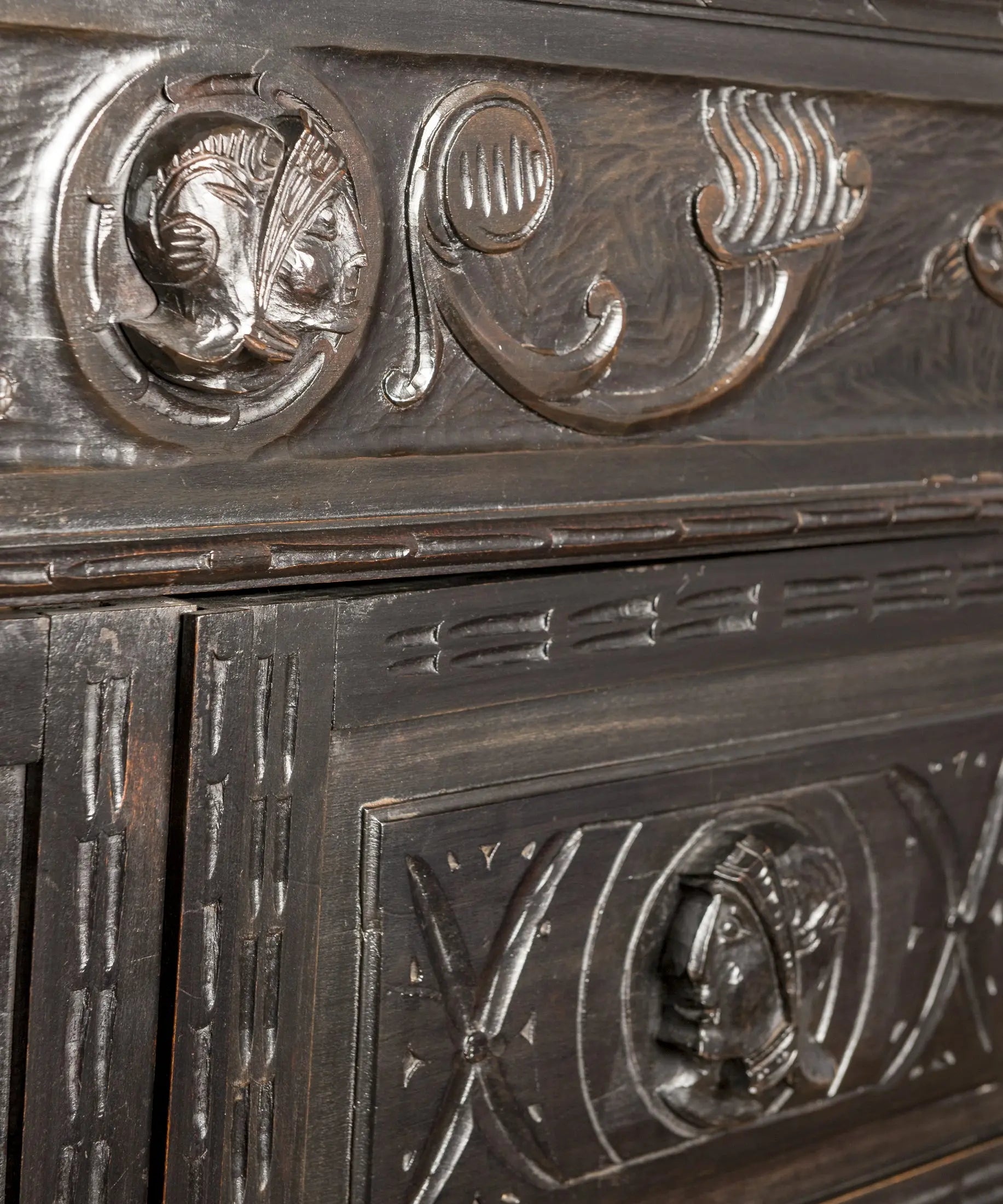
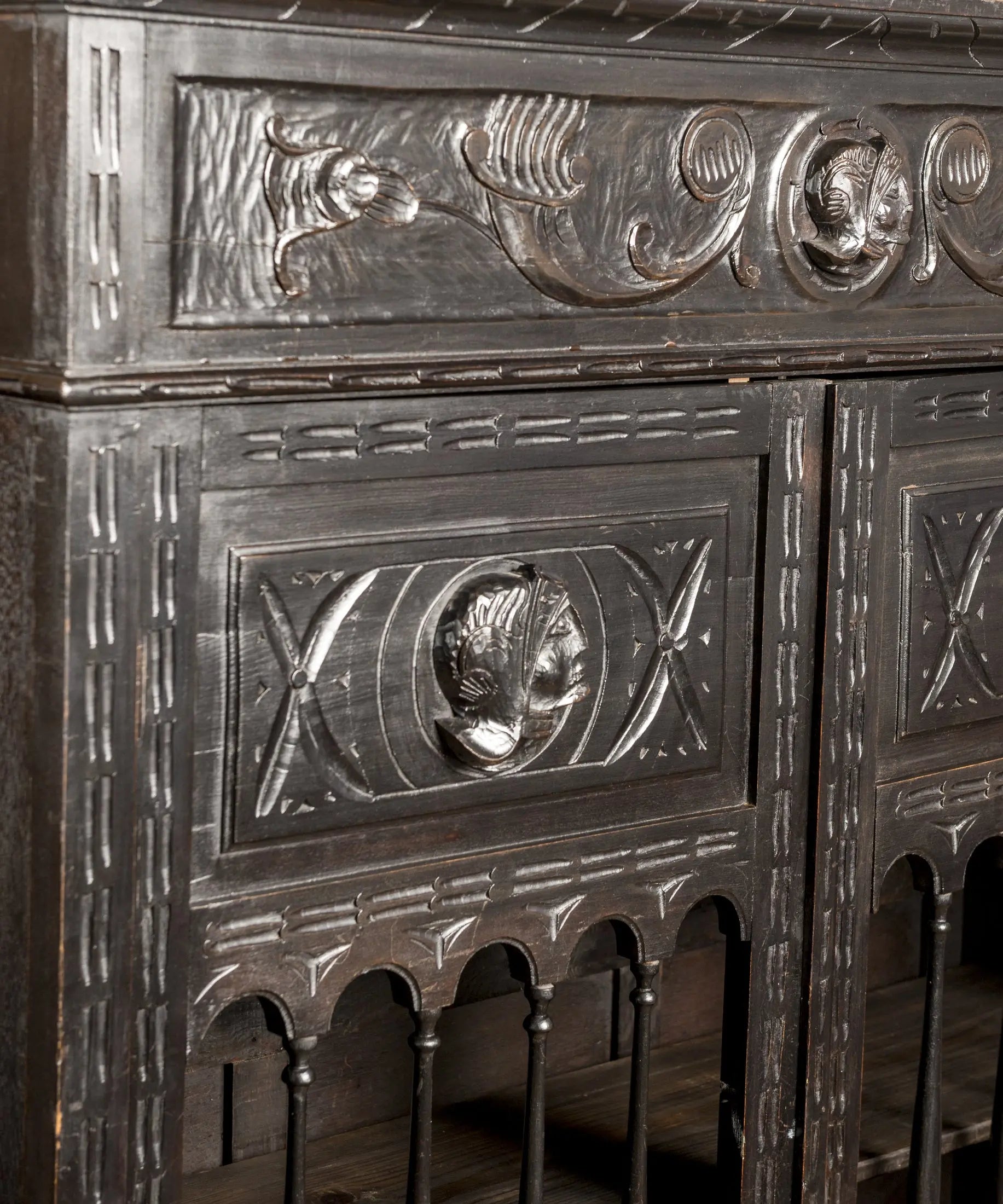
The decorative carving covers the entire front and is executed by hand. The upper frieze features a continuous frieze of low-relief plant motifs with a central medallion carved in high relief. The upper panels of each door feature figurative medallions: animal heads (greyhounds or stylized lions, typical of the Breton repertoire) individually carved – if you look closely, the two heads are not identical, they have slight differences. This is the work of a hand carver, not a pantograph. The lower panels feature solar and circular motifs in low relief within a rectangular frame. The perimeter frames of the doors and the vertical and horizontal moldings of the body are decorated with a continuous galloon or rope-type relief carving. And the piece rests on two carved claw feet at the front.

The finish is what differentiates this piece from any current reproduction. It is not painted black. It is ebonized: treated with a dye based on iron powder and acids (a 19th-century technique to imitate ebony, which was imported and very expensive). Ebonizing penetrates the wood; it doesn't stay on the surface. That's why it has real tonal depth, with reflections that vary slightly depending on the light, and that's why it has lasted over a century without chipping. A modern black paint would be flat, opaque, and would look like any painted IKEA furniture. This is not.

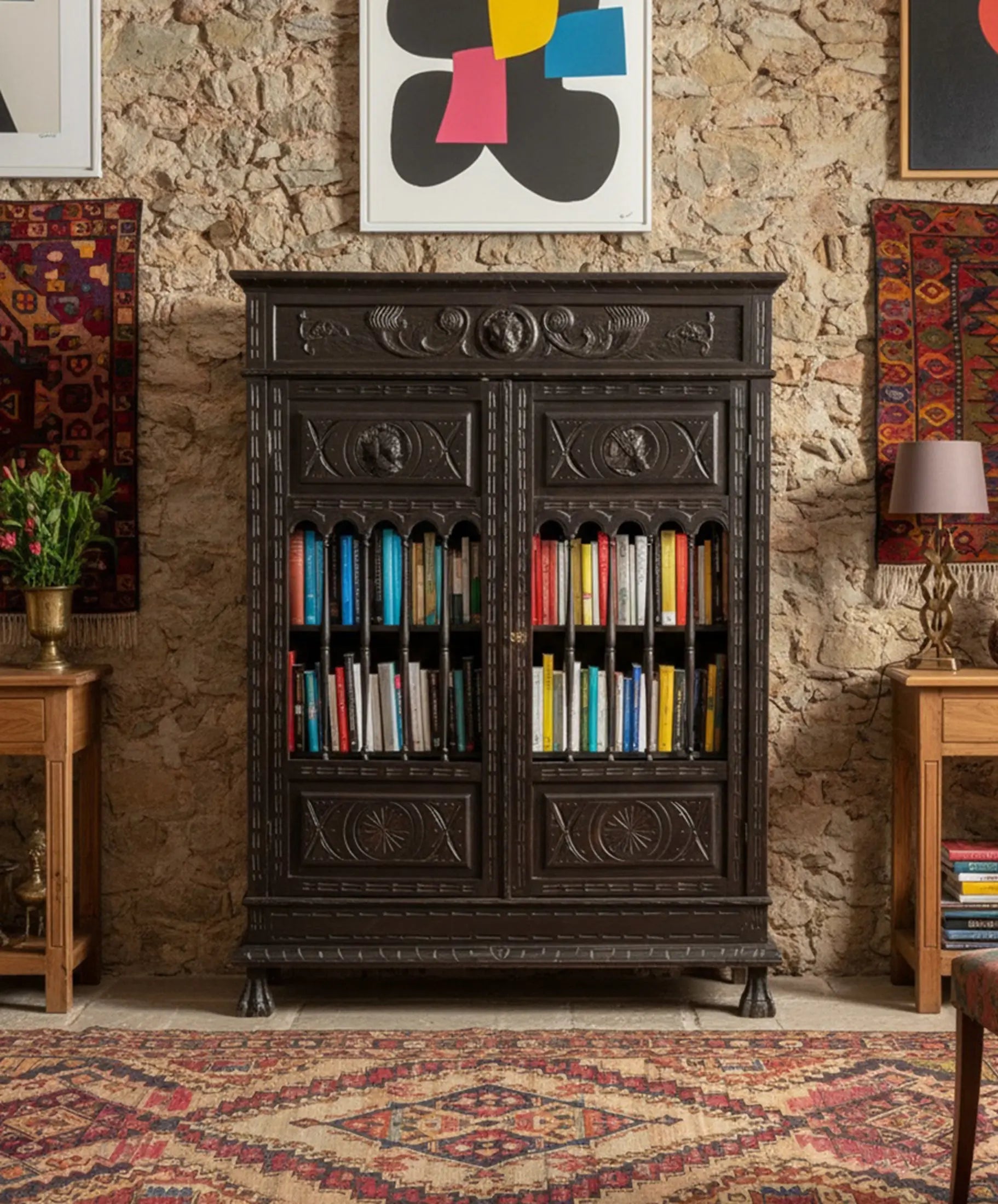
The measurements are those of a functional bookcase for a modern home: 127 cm wide, 40 cm deep, 175 cm high. It fits in apartments with standard ceilings (240 cm), it is not oppressive. The 40 cm depth allows it to be placed against a wall without obstructing passage. And the 175 cm height gives it real vertical presence without the need for built-in bookcases. It works as a main bookcase in a living room or office with 100-200 books, as a statement piece in a bedroom, in a wide hallway, in a spacious entrance, or as a counterpoint in a dining room that already has a lot of presence. In terms of style, it combines well with both eclectic, richly decorated interiors — stone walls, kilims, contemporary art — and minimalist Mediterranean interiors with whitewashed walls and light stone floors, where the contrast between the black carved piece and the clean white works especially well.

Excellent condition. The ebonized finish retains its original color and depth. The carving is intact in all main parts. Both doors close correctly with their central lock, original key preserved. All turned balusters are in place, made of solid wood. The three interior shelves are solid and remain level. The entire structure is robust. A piece that has arrived intact into the 21st century.

It is delivered assembled – it does not arrive disassembled or require assembly at the destination. Ready to place and use.

── WHAT WE LIKE MOST ABOUT THIS PIECE ──

→ The hand-turned balusters on the doors. Each small column is individually turned on a lathe. They keep books ventilated without accumulating dust, which is exactly what they were designed for. This is what differentiates a bookcase made to properly store books from any decorative furniture.

→ The original ebonized finish. A 19th-century technique to imitate ebony. It penetrates the wood; it doesn't stay on the surface. Today it is no longer done because it is slow and chemically complicated. The result is a black with depth that no modern paint can replicate.

→ The carved figurative heads. Breton animals (greyhounds or lions) in the door medallions, individually hand-carved. Each has subtle differences. The central medallion on the upper frieze is similar. If you look closely, the piece has more life than the most expensive industrial bookcases.

── RESTORED IN OUR WORKSHOP IN NAVALCARNERO, MADRID ──

We checked the structure, the two doors, the central lock, and the three interior shelves. We greased the hinges. We treated the wood against wood-boring insects. The original ebonized finish was NOT sanded or repainted – that would have been a serious mistake that would have destroyed the authentic patina. It was only cleaned by hand and nourished with neutral wax to restore its deep shine without altering the tone. The turned balusters were checked one by one. The piece arrives ready to enter a home.

A piece selected and restored by Antique Arte y Decoración – specializing since 2015 in antique furniture, with its own workshop in Navalcarnero, 30 minutes from Madrid, and over 3,500 families throughout Spain.

Material AND FINISH

Style: Renaissance Revival / Henri II, probably Breton
Material: Oak.
Finish: Ebonized.
Carving: Upper frieze with floral border and central medallion carved in high relief, upper door panels with figurative medallions (individually carved Breton animal heads), lower panels with solar and circular motifs in bas-relief, perimeter frames with continuous gadroon-type relief
Feet: Two carved claw feet at the front
Hardware: Original central lock with preserved key, original hinges
Structure: Continuous upper frieze, two wide doors with carved upper panels and a central area of hand-turned balusters replacing the glass, three interior shelves creating four levels for books
Balusters: Hand-turned solid wood columns, each individually turned
Measurements: 127 cm (Width) × 40 cm (Depth) × 175 cm (Height)
Weight: 45 kg
Condition: Excellent general conservation, original ebonized finish intact, carving and balusters preserved
Period: Early 20th century (c. 1880-1910)
Origin: France, probably Brittany
Delivery: Delivered assembled

MEASURES

127 cm (Width) × 40 cm (Depth) × 175 cm (Height)

SHIPMENTS

Free shipping to the peninsula. Delivered assembled — no assembly required at destination. Includes indoor delivery with packaging removal. Due to the height (175 cm) and size of the piece, we manage transportation with companies specialized in antique furniture. Custom packaging, insured throughout the journey.

Librería ebonizada estilo Renacimiento vista en tres cuartos con detalle de balaustres torneados — Antique Arte y Decoración
Librería antigua ebonizada en interior bohemio con paredes de piedra rústica kilims persas y arte contemporáneo — Antique Arte y Decoración
Librería antigua francesa ebonizada con balaustres tallados y dos puertas vista frontal — Antique Arte y Decoración
Librería bretona con puertas abiertas mostrando tres baldas interiores en madera maciza — Antique Arte y Decoración
Librería ebonizada en interior mediterráneo minimalista con paredes encaladas y suelo de piedra clara — Antique Arte y Decoración
Detalle del friso superior con cenefa floral y medallón central tallado a mano — Antique Arte y Decoración
Librería antigua francesa ebonizada vista lateral mostrando estructura y patas de garra — Antique Arte y Decoración
Detalle del panel superior con medallón figurativo de cabeza tallada y motivos circulares — Antique Arte y Decoración

Preguntas frecuentes

¿Por qué las puertas no llevan cristal sino balaustres?

Es un detalle constructivo del XIX que se ha perdido en las librerías modernas. Las librerías cerradas con cristal generan humedad interior, no circula el aire, y la encuadernación de los libros antiguos se pega o se hincha con los años. Las librerías abiertas, por su parte, acumulan polvo en los libros. La solución del XIX fue sustituir el cristal por una hilera de columnitas torneadas en madera maciza — los balaustres — que protegen del polvo pero dejan pasar el aire. Los libros se ventilan, conservan la encuadernación, no amarillean. Era el formato técnicamente correcto para una biblioteca doméstica.

¿Qué es el ebonizado y por qué importa?

El ebonizado es una técnica del XIX para imitar el ébano (que era importado de África y carisimo, reservado a la realeza). Se trataba la madera local — roble, castaño, o frutales — con un tinte a base de polvo de hierro y ácido tánico que reaccionaba químicamente con la madera oscureciéndola en profundidad. El ebonizado no es pintura: penetra la madera. Por eso tiene profundidad de tono real, con reflejos que viran ligeramente según la luz, y por eso este acabado ha aguantado más de un siglo sin desconcharse. Hoy ya no se hace porque es lento y químicamente complicado. Las “réplicas” modernas son pintura negra mate por encima — se ven planas y se desconchan con los años.

¿De qué época y origen es la pieza?

Finales del siglo XIX o principios del XX (c. 1880-1910). Es un mueble francés en estilo Renacimiento revival (también llamado Henri II), probablemente de origen bretón: los medallones figurativos con cabezas de animales (lebreles, leones estilizados) son típicos del mueble bretón del XIX, donde se tallaban los animales locales en los muebles de las casas burguesas.

¿Qué medidas tiene y dónde encaja?

127 cm de ancho, 40 cm de fondo, 175 cm de alto. Funciona como librería principal en un salón o despacho con 100-200 libros, como librería de pieza de carácter en un dormitorio, en un pasillo amplio, en una entrada o como contrapunto en un comedor. Los 175 cm de alto le dan presencia vertical sin invadir techo (cabe en pisos de 240 cm). Los 40 cm de fondo permiten colocarla contra pared sin estorbar el paso. Por estilo combina tanto con interiores eclécticos recargados (piedra, kilims, arte contemporáneo) como con interiores mediterráneos minimalistas (paredes blancas encaladas, suelos de piedra clara).

¿Tiene llave? ¿Funciona la cerradura?

Sí. Conserva la llave original y la cerradura central funciona correctamente. Las dos puertas cierran bien.

¿Se entrega montada o desmontada?

Se entrega completamente MONTADA. No requiere ensamblaje en destino. Llega lista para colocar.

¿Qué trabajo se ha hecho en el taller?

Revisamos la estructura, las dos puertas, la cerradura central y las tres baldas interiores. Engrasamos las bisagras. Tratamos la madera contra xilófagos. El ebonizado original NO se lijó ni se repintó — eso hubiera sido un error grave que habría destruido la pátina auténtica. Solo se limpió a mano y se alimentó con cera neutra para devolverle el brillo profundo sin alterar el tono original. Los balaustres torneados se revisaron uno por uno. Trabajo realizado en nuestro taller especializado de Navalcarnero, a 30 minutos de Madrid.

¿Cómo se gestiona el envío de una pieza de 175 cm de alto?

El envío es gratuito a toda la Península. Por la altura y la talla decorativa, gestionamos el transporte con empresas especializadas en muebles antiguos. La pieza se embala a medida, va con seguro durante todo el trayecto, y se entrega en el interior del domicilio con retirada de embalaje.

¿Qué garantías ofrece Antique Arte y Decoración?

Llevamos desde 2015 especializados en la selección y restauración de muebles antiguos. Más de 3.500 familias en toda España y una valoración de 4,9 sobre 5 en Google. Puedes contactarnos antes de comprar para cualquier consulta sobre la pieza o para pedir fotos adicionales de cualquier detalle (interior abierto, llave, balaustres, etc.).